
You’re planning a new fence, or the one between you and your neighbor is leaning, and the questions come fast. Whose fence is it? Do I have to pay half? Can they attach to it? Get it wrong and you could pay for a fence you thought was shared, build on the wrong side of the line, or end up in a dispute that outlasts the fence.
Here are plain answers on Texas neighbor fence law for homeowners in Austin, Georgetown, Round Rock, Cedar Park and across Central Texas. We summarize two public sources, Texas A&M AgriLife Extension’s fence law handbook and the Texas State Law Library’s neighbor law guide, and link the statutes they cite.
The short answer: According to Texas A&M AgriLife Extension, a fence built on one owner’s land belongs to that owner. A neighbor doesn’t have to share the cost of a fence on the property line unless they agreed to, and AgriLife says that agreement should be in writing. The Texas State Law Library’s neighbor law guide says the same about cost. A neighbor can generally use a fence you built without owing you for it, and state law requires six months’ written notice before an attached fence is disconnected or removed.
We’re fence builders, not attorneys. This is general information, not legal advice. For your situation, talk to a Texas real estate attorney.
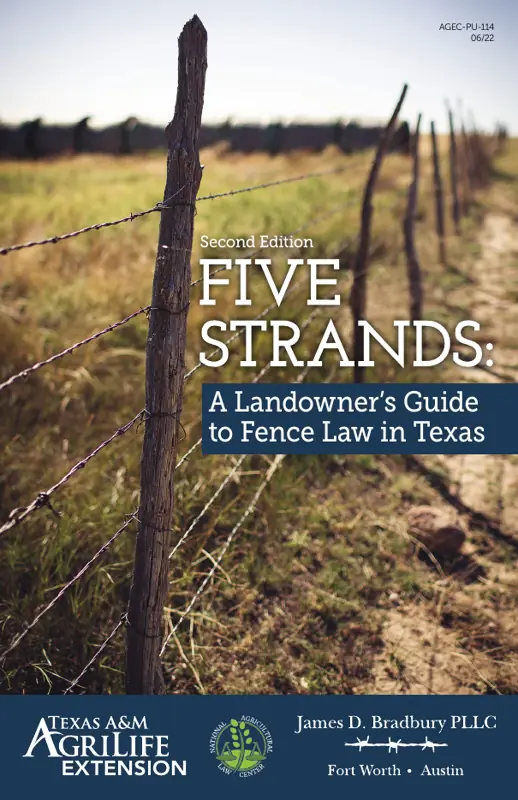
Read the AgriLife fence law handbook (PDF)
Our sources: Five Strands, pages 14–18, the latest fence law edition on AgriLife’s Texas Agricultural Law published materials page as of November 2026; the Texas State Law Library’s Fences & Boundaries guide; and, for storm and tree damage, the State Bar of Texas disaster manual the Law Library links to. Follow the links for the exact wording.
Neighbor fence checklist: what to do first
- Find your survey or plat and see where the fence sits (or will sit). How to find your property line.
- Check your HOA’s fence rules and your city’s height and permit rules. City-by-city rules.
- Talk to your neighbor before you build, replace or remove anything.
- Agree on location, cost, style, which side faces whom, and upkeep.
- Put it in writing, give each owner a copy, and consider recording it in the county deed records.
- Still stuck? See surveyor, mediator or attorney.
Common Neighbor Fence Situations
Jump to your situation:
- My neighbor wants me to pay half for a new fence in Austin. Do I have to?
- My neighbor attached his fence to mine without asking.
- The fence is two feet onto my property.
- A storm or a neighbor’s tree knocked the fence down.
- We want to replace the old shared fence and split it.
- I want to take out the fence between our yards.
- I don’t know where my property line is.
- Our HOA has to approve the new fence.
Who Owns the Fence Between Neighbors in Texas?
According to Texas A&M AgriLife Extension, a fence built entirely on one owner’s land is that owner’s property. A fence on the property line that one neighbor paid for alone is also that neighbor’s property, not a shared fence. If both neighbors shared the cost, it may be jointly owned. Your survey shows where it sits.
The Texas State Law Library’s neighbor law guide notes that Texas doesn’t have a specific state statute on who owns a boundary fence, but court cases over the years address it. AgriLife’s handbook summarizes those cases.
How Do I Tell If the Fence Is Mine or My Neighbor’s? Which Side Is Mine?
Look at where the fence sits on your survey and who paid to build it. AgriLife’s summary ties ownership to location and who paid, not to which side faces your yard. If records are missing, a land surveyor can locate the line, and a written agreement with your neighbor can settle the rest.
Does a Fence Go on the Property Line?
It can, but it doesn’t have to. Many fences sit just inside one owner’s line. Texas A&M AgriLife Extension says an accurate survey showing the boundary is “paramount” before you build a boundary fence. Without one, it says, fence building “is an inaccurate guess and could lead to future headaches.”
AgriLife also notes that if you need to clear brush on your neighbor’s side to build, ask permission first. Without it, entering their property could be considered trespassing, and if they say no, you may have to set the fence back on your side.
How Do I Find My Property Line?
Start with the survey or plat from your closing papers, or the plat your HOA or county has on file. County appraisal district maps help you find your lot and its general shape, but they aren’t surveys. For the exact line, or if pins are missing, hire a land surveyor before you build.
- Your survey or plat. Usually in your closing documents from your title company.
- Williamson County (Georgetown, Round Rock, Cedar Park, Leander, Hutto and more): Williamson Central Appraisal District parcel map. WCAD says its information is provided “as is” and could include inaccuracies.
- Travis County (Austin, Pflugerville, Lakeway and more): Travis Central Appraisal District property search.
- Property pins. Surveyors usually mark lot corners with pins. A surveyor can find or reset them.
Does an old fence show where the property line is? Not necessarily. A Texas A&M Real Estate Center article linked from the Texas State Law Library’s guide notes that fences, especially “fences of convenience,” don’t necessarily establish property lines, and surveys may place the boundary on either side of an existing fence (Whose Line Is It Anyway?).
Do I Have to Tell My Neighbor Before Building a Fence?
Talking first is the best move, and you’ll need permission to work from their side or clear brush there, according to AgriLife. Some city rules depend on neighbor consent too. In Austin, for example, a property line fence can go up to 8 feet in some situations only with the neighbor’s written consent.
Do I Have to Pay for My Neighbor’s Fence?
Generally no, unless you agreed to. Texas A&M AgriLife Extension explains that “a landowner in Texas has no legal obligation to share in the costs or future maintenance of a fence built by his or her neighbor on the dividing property line, unless he or she has agreed to do so.” The Texas State Law Library’s guide says the same.
AgriLife adds that any such agreement “should be done in writing in order to be enforceable.”
Do I Have to Split the Cost of a Fence With My Neighbor?
Not by default. Texas doesn’t require neighbors to split the cost of a boundary fence unless they agree to, according to AgriLife and the Texas State Law Library. Many neighbors split it anyway, especially for a good neighbor fence both sides enjoy. If you do, write down the split, the location and who handles upkeep.
Can My Neighbor Make Me Pay for a Fence?
Generally not without an agreement. If your neighbor builds a fence on the line and asks you to pay half, AgriLife says you have no legal obligation to share the cost or the upkeep unless you agreed to. Check your deed restrictions and HOA rules too, since they may address fences.
Can My Neighbor Charge Me for Using Their Fence?
Generally no. AgriLife quotes the Texas Supreme Court: if one owner puts a fence on their line, the neighbor may use it to enclose their own land “without incurring any liability to account for the use of his neighbor’s fence.” Paying would only come up if you agreed to it.
Who Pays to Replace a Shared Fence in Texas?
It depends on ownership and any agreement. AgriLife says a neighbor has no obligation to help rebuild a boundary fence, even one destroyed by natural causes, unless they agreed to. The State Bar of Texas’s disaster manual says neighbors who both use a fence straddling the line both own it and share repair costs.
Because the sources frame shared-use fences differently, the safest path is a written agreement before the work starts. For repair-specific situations, see our guide to who is responsible for fence repair between neighbors in Texas.
Shared Fence Cost Scenarios
| Situation | What the sources say |
|---|---|
| You build on your side of the line and pay for it | It’s yours. You maintain it, and your neighbor can’t be made to pay for it (AgriLife). |
| You build on the line and pay for it alone | AgriLife says it’s still yours alone, not a shared fence. Your neighbor can use it without paying you. |
| You and your neighbor split the cost | It may be jointly owned. Write down the split, who maintains which part, and what happens at replacement time. |
| An old fence, no records, both of you use it | Sources frame this differently. The State Bar of Texas’s disaster manual says both neighbors who use a fence straddling the line own it and share repair costs. AgriLife says there’s no obligation without an agreement. A written agreement settles it. |
| Your neighbor asks you to pay half of a new fence | You’re generally not required to unless you agree (AgriLife, Texas State Law Library). Many neighbors agree anyway, often for a good neighbor style. |
| Your HOA or deed restrictions address shared fences | Read them. Deed restrictions or HOA rules may address fence responsibilities, style and color. |
Can My Neighbor Attach to My Fence?
Your neighbor can use a fence you built without paying for it, according to AgriLife. Attaching is covered by a 1981 Texas law on adjoining fences. If your fence is wholly on your land, you can require the owner of an attached fence to disconnect it by giving six months’ written notice.
AgriLife summarizes the statute, Tex. Agric. Code §§143.121–143.123, in three parts:
- A joint owner can’t remove a dividing fence on their own without mutual consent.
- If your fence is attached to someone else’s fence, you must give the other owner six months’ written notice before removing yours.
- If you own a fence that’s wholly on your land, you can require the owner of an attached fence to disconnect it by giving six months’ written notice.
The Law Library’s guide also links AgriLife’s article on this removal statute. As of the handbook’s 2022 edition, AgriLife noted no reported court cases applying it, which is one more reason to talk to an attorney about a specific dispute.
My Neighbor Attached His Fence to Mine Without Asking. What Can I Do?
Start with a friendly conversation and check your survey. If your fence is wholly on your land, AgriLife’s summary of the statute says you can require the neighbor to disconnect the attached fence by giving six months’ written notice. Keep a copy of the notice, and talk to an attorney if it turns into a dispute.
Can I Remove a Shared Fence or My Neighbor’s Fence?
Not on your own if you’re a joint owner. According to AgriLife, a joint owner can’t remove a dividing fence without mutual consent. If the fence is your neighbor’s property, it isn’t yours to remove. If a storm knocks a neighbor’s fence into your yard, the State Bar’s disaster manual says you can remove it from your property.
Can I Paint or Stain My Neighbor’s Side of the Fence?
Ask first. If the fence belongs to your neighbor, it’s their property, so painting or staining it needs their OK. Your HOA may also have color rules. For a shared fence, agree on the color and finish in writing before anyone starts, so one side doesn’t end up a different color.
Who Maintains or Repairs a Boundary Fence?
Usually the owner. AgriLife explains that a neighbor has no obligation to help maintain or rebuild a boundary fence they didn’t agree to share, even after natural damage. If neighbors agree that each will maintain part of the fence, AgriLife says that agreement is legally binding and can be enforced.
For leaning posts, rot and other repair situations, see who is responsible for fence repair between neighbors in Texas.
What If a Tree Falls on the Fence?
The State Bar of Texas’s disaster manual says that when a healthy tree falls in a storm, it’s usually treated as an “act of God,” so the neighbor likely isn’t liable. If the tree was dead, diseased or otherwise dangerous beforehand, the neighbor may be. It notes homeowner’s insurance typically covers fallen-tree damage.
- See a dangerous tree? The manual suggests telling your neighbor in writing and keeping a copy.
- Overhanging branches: AgriLife and the State Bar’s manual both say you can trim branches that reach onto your property, but only back to the property line and without killing the tree.
- Filing a claim: The manual notes it may be easier to file on your own policy and let your insurer pursue the neighbor if they’re at fault.
Source: State Bar of Texas Disaster Manual, Section 3, linked from the Texas State Law Library’s guide.
What If the Fence Is on My Property?
Start with a current survey to confirm where the line is. AgriLife says a fence built on one owner’s side is that owner’s property. When a fence sits off the line, AgriLife recommends a written boundary line agreement with your neighbor, filed in the deed records, so neither of you later claims the strip.
If the survey shows a neighbor’s fence is a few feet onto your land, don’t tear it down yourself. Talk to your neighbor and, for an encroachment, a Texas real estate attorney.
Is There a 7-Year Fence Law in Texas?
AgriLife’s handbook doesn’t describe a “seven-year fence law.” It explains adverse possession, which generally requires about 10 years of open, exclusive use without permission, plus other elements. It calls taking someone’s land that way very difficult in Texas. The Law Library links the statutes in Civil Practice and Remedies Code ch. 16.
AgriLife’s example: a neighbor’s cattle occasionally grazing a strip outside your fence usually isn’t enough, but a neighbor building their own fence on your side of the line is the kind of evidence that could support a claim. That’s why a boundary line agreement matters when a fence isn’t on the line.
What Is a Good Neighbor Fence, and Which Side Faces Out?
A good neighbor fence is a style built so both sides look finished, so neither neighbor gets the “back” of the fence. It isn’t a legal term. Which side faces out is usually up to the owner, your HOA’s rules and your agreement with your neighbor. When in doubt, ask your HOA.
Etiquette that keeps the peace: show your neighbor the style and location before you build, offer the finished side or a good neighbor style if you’re splitting the cost, and give a heads-up on build day.
HOA and City Rules for Fences Between Neighbors
State law covers ownership and cost. Your city sets height and permit rules, and your HOA decides style, color and approval. In Austin, a solid property line fence can be up to 6 feet, or 7 feet where the grade changes at least 1 foot, and up to 8 feet in some situations with the neighbor’s written consent.
- Austin: height rules above (City of Austin).
- Georgetown: side and rear fences up to 6 feet in most cases, front-yard fences up to 4 feet and at least 50% open, and a permit for most new fences.
- Round Rock and Cedar Park: no permit for residential fences, but height and material rules apply.
See every city’s rules and sources in our Texas fence laws and permits guide, and how we handle approvals on our HOA fence approval page.
What to Put in Writing With Your Neighbor
AgriLife recommends writing down any fence agreement, giving each owner a copy and recording it in the county deed records. A short written agreement covering location, cost, upkeep and replacement can prevent years of friction. Have a Texas real estate attorney review it before you sign.
An outline of what neighbors commonly cover (not a legal form):
- Names, addresses and the date.
- Where the fence goes, tied to the survey (and whether it’s on the line or on one side).
- Height, material, style, and which side faces which yard.
- Who pays what, and when.
- Who maintains which section, and how repairs get decided.
- What happens if it’s damaged in a storm, needs replacing, or a house sells.
- That the fence isn’t meant to move the property line (a boundary line agreement, if it sits off the line).
- Signatures, a copy for each owner and, if you choose, recording in the county deed records.
Surveyor, Mediator or Attorney: Who Should You Call?
Call a land surveyor when you don’t know where the line is. Try mediation when you know the facts but can’t agree. Call a Texas real estate attorney for encroachments, adverse possession, removal notices or a written agreement. Call a fence company for design, cost and the city and HOA rules.
- Land surveyor: to find or mark the line, or to update an old survey.
- Mediation: the Dispute Resolution Center in Austin lists conflicts between neighbors among the civil disputes it mediates.
- Attorney: the Texas State Law Library lists legal help resources, and it notes the library can’t tell you what the law means for your situation.
- Fence company: that’s us. See below.
Tip: Talk to your neighbor, then get it in writing.
Before you build or replace a fence on the line, talk it through: where it goes, who pays, and who keeps it up. Texas A&M AgriLife Extension recommends writing down any agreement, giving each owner a copy, and recording it in the county deed records.
How We Help With Property Line Fences
Neighbor fence questions are some of the most common ones we hear, and they can be stressful. You want a good fence without a fight next door. Sagamore Fence & Deck is a family-owned fence company that has built fences across Austin, Georgetown, Round Rock and Central Texas since 2013. Our owner, Tony Perez, is Education Chair and cabinet member of the Texas Fence Association (former Vice President). We don’t give legal advice, but we can help you plan the fence the right way.
- Call or get a quote. Call (512) 337-3714 or request a free estimate.
- We check the line and the rules. When we quote, we look at your survey and mark it up to show where the fence goes. If you don’t have a survey, we can coordinate a new one. We also check your HOA approval and city rules.
- We build it right. Our own fully insured crew builds to your survey and the approved plan. Most fences take one day.
If you and your neighbor are splitting the cost, we can give you both the same written quote.
Frequently Asked Questions
Who owns the fence between neighbors in Texas?
According to Texas A&M AgriLife Extension, a fence built entirely on one owner’s land belongs to that owner, and a fence on the property line that one neighbor paid for alone is that neighbor’s property. If both neighbors shared the cost, it may be jointly owned. Your survey shows where the fence sits.
Do I have to pay for my neighbor’s fence?
Generally no, unless you agreed to. Texas A&M AgriLife Extension and the Texas State Law Library both say a Texas landowner has no legal obligation to share the cost or upkeep of a fence a neighbor builds on the dividing line unless they agreed to do so. AgriLife says such agreements should be in writing.
Do I have to split the cost of a fence with my neighbor?
Not unless you agree to. Texas doesn’t require neighbors to split the cost of a boundary fence by default, according to AgriLife and the Texas State Law Library. Many neighbors still choose to split it. If you do, put the split, the fence location and who maintains it in writing.
Can my neighbor make me pay for a fence?
Generally not without an agreement. AgriLife explains that a neighbor who builds a fence on the line can’t make you share the cost unless you agreed to, and the same applies to future maintenance. Check your deed restrictions and HOA rules too, since they may address fences.
Can my neighbor charge me for using their fence?
Generally no. Texas A&M AgriLife Extension quotes the Texas Supreme Court: when one owner builds a fence on the line, the neighbor may use it to enclose their own land without owing anything for that use. If you’ve agreed to pay, that agreement is a separate matter.
Who pays to replace a shared fence in Texas?
It depends on ownership and any agreement. AgriLife says a neighbor isn’t obligated to help rebuild a boundary fence, even after natural damage, unless they agreed to. The State Bar of Texas’s disaster manual says that when both neighbors use a fence straddling the line, both own it and share repair costs. Get any split in writing. See our fence repair between neighbors guide.
Can my neighbor attach their fence to mine?
Your neighbor can use a fence you built without owing for it, per AgriLife. If your fence is wholly on your land, state law lets you require the owner of an attached fence to disconnect it with six months’ written notice (Tex. Agric. Code §143.123).
Can a neighbor tear down a shared fence in Texas?
Not on their own. AgriLife’s summary of Tex. Agric. Code §§143.121–143.123 says a joint owner can’t remove a dividing fence without mutual consent, and someone removing their own fence that’s attached to another’s must give six months’ written notice.
My neighbor’s tree fell on my fence. Who pays?
The State Bar of Texas’s disaster manual says that if a healthy tree falls in a storm, it’s usually treated as an “act of God” and the neighbor likely isn’t liable. If the tree was dead, diseased or dangerous beforehand, the neighbor may be. It notes homeowner’s insurance typically covers fallen-tree damage.
What if my neighbor’s fence is on my property?
Start with a current survey. AgriLife says a fence built on one owner’s side is that owner’s property, and it recommends a written boundary line agreement, filed in the deed records, when a fence sits off the line. For an encroachment or an adverse possession concern, talk to a Texas real estate attorney.
Is there a 7-year fence law in Texas?
AgriLife’s fence law handbook doesn’t describe a “seven-year fence law.” It explains adverse possession, which generally requires about 10 years of open, exclusive use without permission, among other elements, and it calls taking land that way very difficult in Texas. The statutes are in Civil Practice and Remedies Code ch. 16.
Is there a good neighbor fence law in Texas?
Not a law that makes neighbors split the cost. AgriLife and the Texas State Law Library both say sharing the cost is up to the neighbors unless they agree to it. A “good neighbor fence” is a style built so both sides look finished, which often makes that agreement easier.
How do I find my property line in Texas?
Your survey or plat is the best place to start, and AgriLife calls an accurate survey paramount before building a boundary fence. The Williamson CAD parcel map and Travis CAD property search help you find your lot, but appraisal maps aren’t surveys. For the exact line, hire a land surveyor.
Can I paint or stain my neighbor’s side of the fence?
Ask first. If the fence is your neighbor’s, it’s their property, so painting or staining it needs their OK. Your HOA may also control fence colors. If you share a fence, agree on the color and finish in writing before anyone starts.
Sources
- Texas A&M AgriLife Extension, Five Strands: A Landowner’s Guide to Fence Law in Texas, Second Edition (AGEC-PU-114, June 2022), pages 14–18.
- Texas State Law Library, Neighbor Law: Fences & Boundaries.
- Texas A&M Real Estate Center, Whose Line Is It Anyway? (2007).
- State Bar of Texas, Disaster Manual, Section 3: Falling Trees, Flying Limbs, and Related Noises (TexasLawHelp.org).
- Texas Agriculture Code §§143.121–143.123 (removal of adjoining fences); Civil Practice and Remedies Code ch. 16, subch. B (adverse possession).
- City of Austin, fencing regulations; Williamson CAD parcel map; Travis CAD property search.
We’re fence builders, not attorneys. This is general information, not legal advice. For your situation, talk to a Texas real estate attorney. Last checked: November 2026.
Planning a fence on the property line? Call Sagamore Fence & Deck at 512-337-3714 or request your free estimate. Built Right.